On the Topic of First-Generation Students

The first true semester of my physical therapy education is now in session–and it’s undoubtedly a beast. Seven classes which anyone can look up on my DPT program’s curriculum page (Virginia Commonwealth University). I’m only two days in but I fully admit to feeling overwhelmed. I know the feeling will pass once I get a feel for the semester. Anyways, what better way to start procrastinating than to write an extensive blog post instead of reading about cell biology? (I’m less worried because cell biology is my strong suit!)

For this comprehensive post, I thought that I would discuss another topic that is personally pertinent: status as a first-generation student of higher education. When most people think of diversity, especially in the context of education or employment, they think of geographic location, age, religion, socioeconomic status, gender, race & ethnicity, sexual orientation, etc… Just speaking from personal experiences, an often overlooked category is status as a first-generation student. What does that even mean? Status as a first-generation student means that neither of your parents (or broadly, immediate family members) achieved a bachelors degree level of education. So, like myself and many others, I was considered a first-generation student for admission into college and PT school. Okay, why should I care about this arbitrary diversity metric? If you’re reading this and have parents with one or more bachelor’s (or higher) degree(s), I would ask you to think back to the high school days where your parents prodded you about college. Likely, they gave you passionate lectures about college’s importance and drew from personal experiences. Can you try to imagine where you’d be without that push? Maybe there wasn’t a lot of prodding and you found the importance yourself and perhaps through the peers/educators who surrounded you.

Of course, I can’t speak with direct experience on this. If I’m blowing it out of proportion, let me know. Indirectly, I have worked with students whose parents are hyperinvolved their child’s future, admittedly to the point of annoyance or even application detriment. Still, I feel envious for those students whose parents were so deeply involved in their child’s future and educational pursuits. These are the parents who have directly experienced the kind of transformative education most institutions hope to facilitate. They intimately understand the direct and latent value of an education.

All of this to say that this is not the case for many parents, and subsequently, for their respective child/children. I even feel slightly privileged for my own case as a first-generation student: my parents certainly understood the value of an education, but definitely not the practice of it. As in, they knew that I had better go to college and that it was an important step, but they offered little knowledge on how to actually get me there. I was also fortunate to have an older sister who attended college before me and while she gave me the best advice she possibly could, the advice was limited to something along the lines of ‘don’t go where I went, here’s why it sucked…’ Even that was better than nothing. The reality is that, in many families with aspiring scholars, higher education is simply not a priority and these students have no family members to support their pursuits. When discussing first-generation status, most people associate it with immigrants. Yes, this is the case for me personally (not that it should diminish its significance), but I encourage you to recognize that this is a status that spans virtually every location, race & ethnicity, and age in this country. Furthermore, status as a first-generation student is recorded criteria in college and graduate level admission. If you yourself are educated, the level of education of your community should matter to you.

I believe in education as the great equalizer for socioeconomic mobility. And if I haven’t made myself abundantly clear, this first-generation status is important to me. It has seen my parents work back-breaking and gruesome hours to provide whatever support they can for me and my sister. It has led them to poor financial decisions, loss of savings, and no concrete future financial plans. For myself, my first-generation status has meant that I live with the constant pressure to manage both my own finances and that of my parents. It has also manifested into never taking for granted the graciousness of others. What I mean is that if financial stability fosters independence, financial instability fosters reliance/dependency. Now if that sounds bad to you, I would shift the perspective and say that I am not where I am today because of myself, but because of the good people I’ve met along the way (although I wouldn’t call myself successful… yet). I have a tendency to rely on others more, but (hopefully) I do it in a meaningful way that fosters connection. This whole topic has been on my mind because of the gracious people I’ve met in class already.

The first-generation status can be a part of one’s identity. It is certainly a part of mine. Yes, it often means that I can be financially stingier than others and that I’ll be more vocal when school activities force us to spend even more money. However, I am extremely proud of being first-generation. It has taught me never to underestimate the power of an education, to be unafraid of vulnerability and even taught me how to prioritize my finances: I spend on what’s important–people.

Thanks for reading. Please share with me your thoughts and perspective, I’m very curious to hear them. Comment here on WordPress or on IG @firstwealthhealth.

ASJ

Week 7.5: The End of Gross Anatomy & What’s Ahead

Hey there, thanks for stopping by. This blog post marks the end of my class’s 7-credit Summer Gross Anatomy course. For fun at the beginning of the semester, I thought I would reflect on the progress of each week. Now that we’ve come to the end of it all, I thought I would take a bigger picture look at the class, essentially share a miniature version of my course evaluation, and revisit my expectations which I wrote about on June 16th.

Gross Anatomy was a summer intensive, immersive course. We took only this class and met almost every day for it, for up to 5 hours a day not including TA-led review sessions. The summer intensive is fairly unique from what I have seen from other programs (although I can’t confirm this). All I know is that I enjoyed this format. My undergraduate institution featured a similarly intensive, one-course, 4-week term and Gross Anatomy reminded me quite a bit of those very unique terms of my past. That’s not to say it was perfect–I would not describe anatomy as the best subject for an intensive course. Particularly, the learning of anatomy doesn’t leave a lot of room for interpretation or creative expansion. Let’s just say that by the end of the 7.5 weeks–I was more than ready to be finished.

So, moving onto what would be more of my course evaluation, 7.5 weeks was probably almost the perfect number of weeks. Any longer and I really would have lost most of my steam. I don’t have too much more criticism that would be relevant to random internet readers as it mostly pertains to class structure suggestions. I appreciated (and moved on from; his most common expression) our professor, Dr. Mayhew, the tireless effort of the TAs, and whoever contributed to building our class of 59 students. Overall, I have overwhelmingly positive sentiments about the class.

The part that I am most excited to write about is definitely how my expectations have turned out. It is a rare thing to be able to say that what you planned and expected actually came to fruition. I could go on and on about it but I will simplify it mostly for my own privacy: I’ve learned that the key to change is calculated and incremental goal setting. Whether it’s wanting to play more recreational sports or engage in more outdoor activities, aim to pick up that ball/activity once a week and build up from there. Totally unrelated but I also can’t stress the connection between moving the body and mental health. That’s a whole other topic for another time. Nothing meaningful ever comes overnight. Work towards something. Build it. Fail and break it down but build it up again. Aim for perfection but don’t expect it.

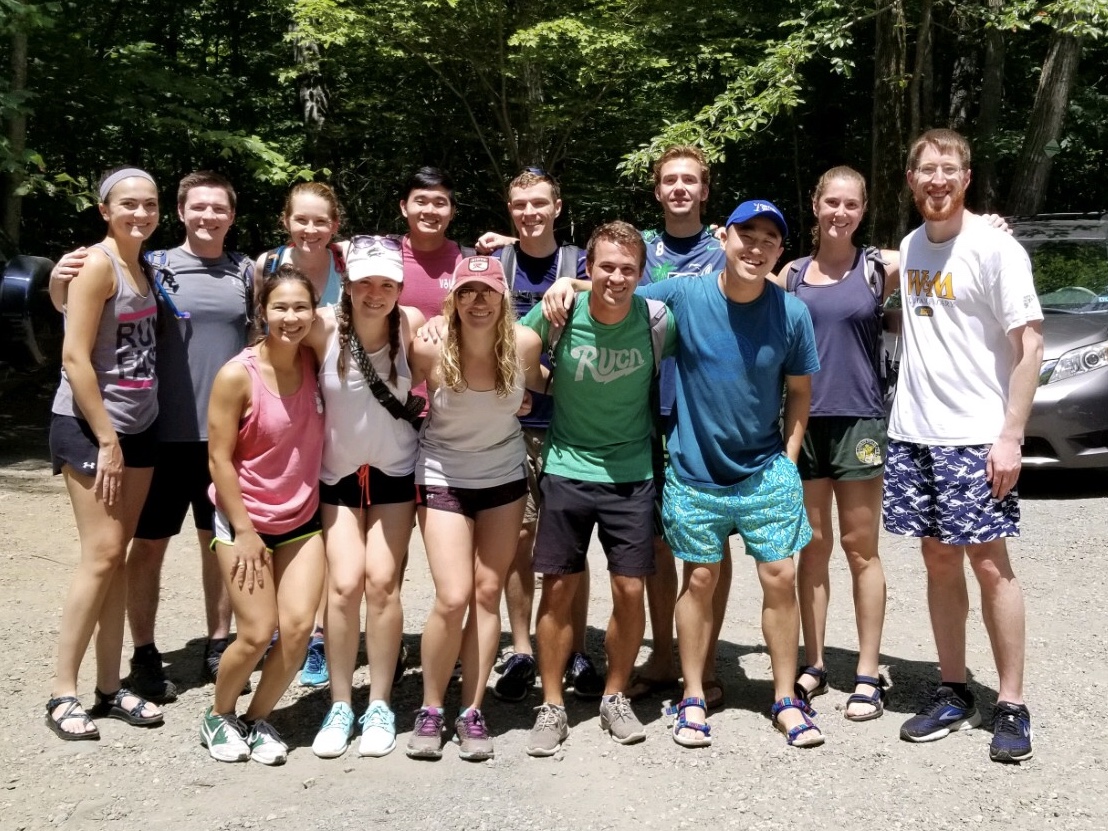
Backpacking crew does McAfee Knob

Okay, enough of the cheesy reflections and attempts at motivation. Fall term draws near but before then I have a recently concluded backpacking trip along the Appalachian Trail, my first-ever trip to the state of Florida, and I guess I’ll work somewhere in there, too. The blog posts will slow down from this point on. I have a few things in mind for what’s in store here. I’ll probably write another expectations post for the Fall semester and definitely some more application advice for pre-PT students. Somewhere in there I’ll write about my personal experience with weight loss and how it has correlated with my mental health. If you should have any other ideas, let me know! Comment here on WordPress, or on Instagram @firstwealthhealth. As usual, thanks for reading.

ASJ

Week 6: Moving Too Fast!

Sunset viewing on Libby Hill Park with a few classmates

What a week. The beginning of it, which started with our second exam, feels like it was weeks ago! Grades are ~80% set at this point meaning that, if you’ve done well up to this point, finding the motivation to study can be difficult. We started the final unit with a lecture on cranial osteology, the face, muscles of mastication, and muscles of the anterior neck. Dissection was tedious, but mostly successful. Oh and we also removed our cadavers’ brains. Well, at least those groups whose brains were well preserved got to remove them (my cadaver’s sadly was not). That’s about all I can muster in academia.

The week was mostly a social one. If my mother could read this, she would probably be disappointed with my lack of studying. The week started with a game night, a sunset viewing at my favorite view of Richmond, and just ended with a morning hike/swimming hole time. Writing quality is at an all-time low here as I try not to fall asleep at 5pm. I’m substituting quality writing for pictures this week. Cheap trick, I know.

The Sugar Hollow trail gang; mostly SPT’s

I’m struck by how (mostly) seamlessly everything related to our class has gone. PT is an innately social career so I guess it makes sense that we get all get along without issues. And of course, time sure has flown by. There will be one last update next week and maybe one final wrap-up of Gross Anatomy to close it off. Anyways, I’ll plan on more structured posts moving forward, but less frequently. That’s all I’ve got for today!

ASJ

Week 5: Balance

Another late week-update post because, again, we had an exam. I admit it’s a bit difficult to give extensive life updates about this program because, week-to-week, not that much is changing. Instead, the theme for this past week’s reflective is about making adjustments and finding a decent life balance.

I may not have written about it in my last post, but I think I overdid the studying for the first exam. It got to the point where I wasn’t sleeping, and making poor dietary choices. The night before the first exam, I spent the night tossing and turning. And following the first exam, it made it really difficult for me to find the motivation to study again. For this second exam, I made it my goal not to repeat that miserable experience ever again.

Honestly, the combination of the low motivation and setting the bar pretty low with this goal made it pretty easy to achieve. Simply, I studied a little less, which I was doing already because, you know, low motivation, and I spent a little more time doing/maintaining my leisurely pursuits. I mean, I even participated in fun activities the night before the exam. I wrote my most recent and extensive blog post about some PT school admissions advice. I’m writing this post the morning before lab because who really needs to prepare for lab… (side note, we’re cracking open all of the lower extremity joints this morning–cool stuff). Jokes aside, little efforts to improve your mental health as a student go a long way.

That’s all for this one. Thanks for reading!

ASJ

5 Pieces of Advice for Your PT School Application

Before I was an SPT… I was an admission counselor

If you’re reading this–thank you for stopping by. This will be my first non-week-update post on a topic I feel pretty comfortable writing about: admissions. But first, a little background about why and how I feel okay about writing about this process. No, I unfortunately don’t have a M. Ed, but I did spend about 2.5 years working in higher education admissions. I was a full-time admission counselor at my alma mater for 2 years, and even did some seasonal travel and seasonal reading after my full-time employment ended. I’ve personally read over 2,000 applications, and even more essays. I have an intimate understanding of the nuances of the CommonApp, or in general, CAS systems.

Now, I’m an SPT at a school that was one of my top picks. Just over a year from this time, I was in the same shoes as the thousands currently grinding away at their applications. If you’d like to read more about my personal admissions process, let me know and I’d be happy to write about it. In the meantime, this post is meant to be an introduction into some of my basic thoughts to improving your application–from a former reader standpoint. If you’re currently applying, I hope this can help. In fact, let me know if it does!

1. Reduce Redundancies

I have seen a ton of redundancy in applications. Perhaps it’s different now that most PTCAS applicants have gone through college (or most of it). However, even in advising some of my friends for various graduate programs, I have continued to notice the extent to which they don’t understand what I mean by redundancies. Here’s an example: in a personal statement, why share the intimate details in of a shadowing/observation experience at X clinic when you already had the opportunity to elaborate on it in a resumé , CV or an extracurriculars list. The general rule of thumb is this: if you’ve written about it anywhere else on your application, you probably don’t need to say it again.

Of course there are exceptions. If there is something in your life/experiences you feel needs to be emphasized, by all means, please do! The risk you run with spending too much time on one topic is coming off either one-dimensional, or perhaps as a poor self-advocate. Readers recognize that people are more than just students or athletes. You’re doing yourself a disservice if you don’t take the opportunity to present the best of yourself in all areas of your life.

2. Be Specific

On the contrary, not being specific enough can also hurt your application. Admissions can feel like a huge competition, especially if you’re surrounded by others who are also applying. However, don’t let this translate into cheap, resume building tactics to make sure you have all of the boxes checked. Personally, I would much prefer to see a few, deep commitments which can be elaborated on with detail over a multitude of one-year activities you started in an attempt to appear a stronger applicant. Basically, seek out the things that you love to do, and really do them! Immerse yourself in those things, form opinions, and show off your compassion with detailed examples in your writing.

What I’m trying to say with this second piece of advice is that when you are writing your samples, it’s not just about what you did, it’s about how you got there, and why you decided to persist. Share your story by being vulnerable. No one is expecting you to have been president of every single club you were a part of. If you were, more power to you but you’d better be ready to share the intimate details and make the connections to help readers understand your compassion.

3. Utilize Data

There are a multitude of ways to get yourself more informed about the process. For example, a few months after each cycle, PTCAS releases its Applicant Data Report (link to most recent report). Besides simply being interesting to peruse (ex. 1 student applied to 104 schools last cycle!!!), there is a ton of data that can be relevant to how you think about your application. Notably, there’s been an overall decrease in applications between the most recently completed cycle and the one before it. It means that, on average, most programs saw less applications than they did the year before and this could suggest a shifting approach for some schools in the coming cycle. Also, I think it’s of particular interest to look at age, sex, state of residency, and ethnicity statistics.

And of course, take some time to look at the academic statistics. What are the GPA statistics and how do you stack up? What majors have the most success in getting admitted? If you attended a school with many applicants, how has your college done in terms of admission rates? I could go on and on. Go through it all. See how you fit into this process.

The last part of this is to say that many programs actually offer their own versions of a data report. In the undergraduate realm, we referred to them as ‘class profiles.’ If a program doesn’t have a nicely packaged pdf document in a public-facing website, it may be worth sending an email to ask if they do. Or alternatively, ask via email but be specific about what statistics you’re looking for (app #’s, yield rates, most recent class demographics, etc…).

4. Empathize with the Reader

This is a quick one. A typical graduate-level admissions committee consists of 2-3 primary readers. Have the awareness that each one of these readers is probably reading hundreds of applications. Try to recognize the ‘typical’ physical therapy student and think about ways to save their sanity. A happy reader is something you want. Change it up, keep it quirky, and unabashedly be yourself. Be sincere.

5. Pick Your Editors Wisely

There’s no surprise in saying that essay-writing is an incredibly personal deed. The people who you choose to share your writing with can have an incredibly direct impact on your essays. My advice here is simple. I think most would agree that the more eyes on an essay, the better. However, recall that the original words are yours. Ultimately, it is your choice whether or not you want to make the changes someone suggests. If there’s a change you don’t agree with–that is okay. Simply don’t.

That’s not to say that you should never take the editing suggestions of others, just recognize that the path and flavor of writing can change pretty drastically with even a few edits. I imagine this is a much smaller problem in graduate school admissions, simply because the applicants are a bit older, and hopefully a bit more sure of themselves.

That’s all I’ve got for this post. If you’ve read this far–thank you! Contact me or comment below with any questions.

ASJ

Week 4: A Strange Week

Late post and I’m sorry. The order of week 4 really set me for a spin. Our exam was Monday, which my last post was about. Afterwards, we went almost immediately into shoving new material. The week was short, but also felt long? This post will truly be a short one.

My first exam went well! I think I hesitated to write this post because it’s a little off-putting to write a post simple to say things went great. Anyways, we started the lower extremity last week and we are still at it. Two more lectures and labs and then we have our second exam (also worth another 40% of our final grade) a week from today’s post.

The grind is back on! I had a great weekend and a friend came to visit very last minute. I went to a concert and hung out with some old work friends. I admit there wasn’t too much studying… That’s all for now! I’ll post again after the second exam. Wish me luck.

Week 3: A Tough One

Hey all, this one’s going to be a short one. I am truly, honestly tired. I held off writing my week 3 post until today because, educationally, today was the last day of the week. By that I mean that our class had our first exam today. An exam worth something like 38% of our entire grade, and there’s only something like five weeks left.

Preparation for the exam took it out of me. And no, there was no procrastination! It’s just that this first unit contained a ton of material spanning the vertebral column and the entire upper extremity. I’m surprised that I mustered the effort to even write this at all, to be frank.

If I make it sound awful, I don’t mean to. If there’s one thing to take away it’s that if there’s something you love to study–you will study it regardless of the volume of material. I have enjoyed the material thus far and I’m certainly proud of the factual information contained in my brain about the anatomy of the back and upper extremities.

Thankfully, we have a late start tomorrow and no lecture. I’m taking a break from studying tonight and also probably engaging in an intense session of zoning out. It’s going to be so great. See ya in a few days!

Week 2: The Good and the Bad

Week two of our fully-immersive, seven-credit gross anatomy class was a long one. And looking at the schedule ahead–it should have been one of the longest because of the amount of material we are having to cram in. The weeks moving forward have a few more study days laced in between class days, whereas the past week… was truly a full week of class. We even had lecture and lab before our quiz.

Speaking of the quiz, I am happy to report some good news on that front. I am happy with my score and the class average was high. Everyone’s hard work definitely paid off. But more importantly, the class got an insight into the kinds of questions our professor likes to ask on an exam. The quiz was a low-pressure 25 questions and a maximum of 2% of our final grade so… regardless of what you scored, a good grade in the class, overall, is still achievable.

The bad: I am exhausted. The combination of a full week of material and a busy social calendar really took its toll. I am definitely looking to scale back this week. I am discovering that this is likely to be a difficult cause when our class of 59 students spends so much time together already. I guess it’s just a matter of saying no.

The week’s schedule looks much more manageable, but not more manageable in terms of material. We are spending the last of our lectures before the exam on the forearm, wrist and hand. It’s also a holiday week and our exam is precariously scheduled on the Monday after Independence Day weekend. We’ll see how it goes.

Week 1: Drowning with New Friends

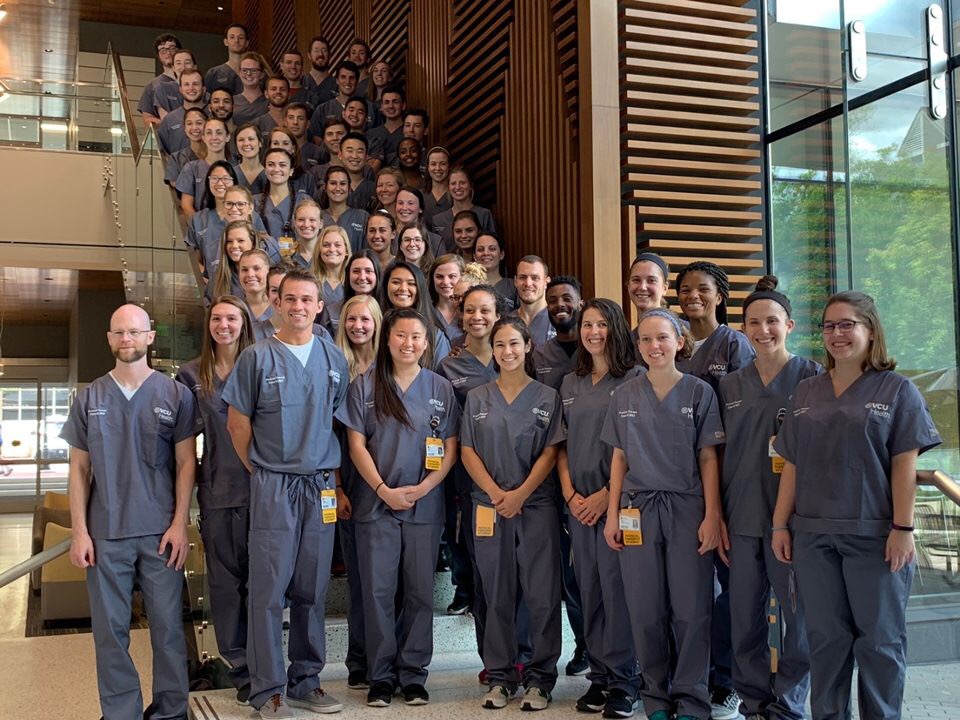
Class photo immediately after our second day in the cadaver lab; we stunk of formalin

There aren’t many things that quickly connect people together in a genuine way. A fast-paced academic environment, however, will definitely do that for a group of people. Such was the case this past week. Our class is largely a group of strangers but after a few cadaver labs, a potluck and a series of lectures that doesn’t seem to end–we persisted as a group. New friends are a plenty and later on in all of our careers, that will probably lead to business partnerships and a group of people that just ‘get it’ the way you do. I’m sure by the end of this program that these people won’t just be classmates, but something akin to family.

Thus far, we’ve had an incredibly supportive and collaborative group. I’m sure that’ll change a bit as we get more comfortable with the pace of things and the inevitable cliques begin to form themselves. Over multiple days, though, I’ve had both the opportunity to have healthy academic recourse with my peers but also the space to work on my own.

There haven’t been many negatives to my experience so far. Mostly just trivial things like the fact that because our building is so new, we are only allowed to eat food in (not very large) designated areas. Or the fact that our building closes pretty early and isn’t open on weekends. Most of these ‘negative’s are totally excusable, anyways.

PT school is no joke. Maybe this is the case for all graduate-level studies but I can’t recall the last time I have encountered such a breadth and depth of material. This kind of program will take a consistent mental fortitude, a willingness to collaborate, and a ton of flexibility. Despite the amount of busy work, I love how relevant all the material is to what I will be doing. After almost two years as a rehabilitation technician, I am finally connecting the dots that I only ever previewed as a tech. It’s a shame how little being a tech has helped me so far. Don’t get me wrong, teching was a great experience, but it’s only relevant clinically, and not at all in the study of gross anatomy. I can’t wait until some of the more clinical classes.

Anyways, I’m proud to say that I survived my first week in PT school. ‘Survive’ really is the right word since I feel like I’m barely keeping up. Even now as I write this post, my anxiety for my first quiz grows and it demands that I go back to studying. And I will, but not before I finish writing this post. The best part, though, is how excited I am to get back at it.

Until next time!

Expectations & Plans

For my second post on this blog, I thought it would be an entertaining exercise to write down some of the expectations I have about graduate school and forthcoming DPT degree. I’m conveniently writing this post the night before my program begins. What do I expect my program to do for me?

One day, long after I finish my degree, I’m sure I’ll revisit this post with distaste and embarrassment. But tonight, I am mostly filled with the excitement that I will likely learn many things. I expect that I will even learn many things that I might not have ever wanted to learn. I expect that I will make connections with my classmates and, hopefully, my professors. So far, I’ve already met about 1/3 of my classmates and our program hasn’t even started yet. I expect that I’ll attend more than a few college basketball games, since it’s the ‘big’ sport at my university. I expect to get the ‘big-school’ experience I never got at my tiny undergraduate institution.

I expect, for myself, to get more involved in the things I never got to in college. In college, I mainly devoted myself to track & field which, don’t get me wrong, I definitely loved–it was an invaluable experience that was a foundation to me picking this career path. However, I have to admit that it definitely got in the way getting more involved in outdoor activities and even recreational sports. Originally, I intended for this post to be solely about what I expect. It has quickly evolved, also, into what I plan.

I plan to be the best student I can be, while also being the best peer, friend, and family member, too. I plan to work hard, but never be stuffy about it. As per usual, I plan to be my flexible, dynamic self. I plan to get more involved in outdoor activities, devote myself to more volunteer hours and maybe try a new sport. I plan on being more proactive, and less reactive in all the situations in my life. For me, this means that I plan to take more initiative to plan things myself and get others involved. I guess I plan to try and be a leader, as often and as best I can. Simply, I have plans to be the PT–no, the best person I can be.

Thanks for reading, wish me luck on my first day, and let me know if I’m blowing my expectations & plans out of proportion. Until next time.

ASJ